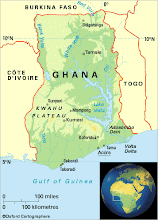
Tuesday, 19 January 2010

Day 2: Tuesday, 12 January

We travelled to Cape Coast to visit Kakum National Park and the former slave fort at Elmina.


Ghana’s Roads

The journey from Accra to Cape Coast was our first real experience of Ghanaian roads and Accra’s horrendous traffic. It probably took nearly two hours to get out of the capital and onto the main Cape Coast road. Some of the traffic jams are caused by road works taking place to widen and improve the main highways.


The main road to Cape Coast was good and progress was fast.


Road safety, or rather the lack of it, is a major concern. Cars often travel very fast and overtake in dangerous places despite road markings prohibiting such manoeuvres.


It is not unusual for vehicles to be overloaded with both people and goods and, if the thick black smoke and dodgy tyres and suspension are anything to go by, many are poorly maintained and would not be considered roadworthy in the UK. There are many examples of unsafe driving practice, including not wearing crash helmets on motor cycles (despite it being the law to do so), carrying passengers on the back of lorries, adding additional seats to tro tros (minibuses) which are the main form of public transport and driving at night with faulty (or nonexistent) lights!


In an attempt to improve the situation, there is an on-going campaign to raise awareness of the dangers. Most main roads also have traffic police check points where some of these hazards are addressed. However, a number of Ghanaians have suggested that some police officers would be prepared to accept money to turn a blind eye.


We are fortunate to have the services of an excellent and very experienced driver. Anyone travelling to Ghana on holiday would be well advised to only travel during the day and ensure that car hire comes with a driver who has experience of dealing with the many challenging road conditions in the country.

The journey to Cape Coast also gave us a glimpse of many people’s living conditions and working lives. It was surprising to see that just a short distance outside the capital city many people living in small communities with buildings constructed in a traditional way with clay walls and roofs made from leaves or thatch. These homes were in stark contrast to the villa we were staying in.


Many people earn a living by trading from roadside and market stalls. A range of new and used goods are sold as well as a wide range of food stuff.


The scenery was very green. There were many small scale pineapple growers selling the delicious and very sweet Cape Coast pineapples by the side of the road.


Kakum National Park
Kakum National Park is just north of Cape Coast in an area of protected rainforest. I overcame my dislike of heights (by not looking down!) to negotiate the seven spans of the canopy walk.


Doris was our expert guide for the nature walk on the floor of the rainforest. She explained about the ways in which the plants of the rainforest are still used in traditional herbal medicine.

Meeting the locals
After leaving Kakum National Park, we stopped at a cafe and met some of the locals – we decided this bench was taken!


Gulf of Guinea


Fishing is how many people earn their living in this part of Ghana. Every evening except Monday many small boats set out to sea for a night’s fishing.


The slave fort at Elmina

As a teacher of History, man’s inhumanity to man throughout the ages, which sadly continues to the present day, has never failed to astound me. No episode of history illustrates this more profoundly than the enslavement of millions of Africans from the 15th to 19th century. The string of slave forts along the West African coastline is a poignant reminder of the suffering that once took place here.


Saturday, 16 January 2010

Day One

On 10 January I woke up to the scene below in my back garden and temperatures of -1 degrees.


24 hours later the temperature in the villa’s garden was much warmer!


Monday was a day for sorting out the essentials. A trip to the recently opened and nearby shopping mall meant a visit the supermarket to stock up on food and water. Whilst supermarkets are nowhere near as common as in the UK, those that do exist are the same as virtually everywhere else in the world. Whilst locally produced bands are reasonably priced and often significantly cheaper than for similar products in the UK, the price of well known brands imported from abroad are expensive, e.g. a small box of Kellogg’s cornflakes cost about £3. Fortunately for me, Coca-Cola is readily available throughout the world and usually much cheaper than in the UK, even if the Diet (Lite) variety is a little more difficult to come by.


Miriam, who doubles as our villa manager and chef, accompanied us to the mall and advised on the ingredients we would need for some typically Ghanaian dishes, so chicken and red snapper fish went into the trolley. She also suggested we bought the fruit and vegetables from one of the many roadside sellers as the produce would be fresher and cheaper from these outlets. Buying from such traders also has the added benefit of supporting small producers and individual traders rather than the large supermarket chains.


Mobile phone and internet connection was organised in the shopping mall. Without the internet I would not be able to complete my blog or keep track of Arsenal’s successes on the pitch! I was amazed to learn that it is cheaper to use a mobile phone to call the UK (using a Ghanaian SIM card) than it is to use a mobile phone to make calls in the UK – what does this say about the cost of calls in Europe?!

The highlight of Day One was meeting Alfred and his wife Grace for lunch. Alfred is the Global Partnership Co-ordinator at one of Walton High’s partner schools, Jamasi Methodist Junior High School. At this meeting we learnt a lot about Ghanaian society and the challenges facing teachers and students in state schools across the country. Both clearly have a lot to offer the Ghana Education Service so it was disappointing to learn that they were thinking of moving to the USA. Unfortunately it appears that teachers pay does not compare favourably with other public sector workers, such as nurses. As a result we have been told that for many people teaching is a career taken up as a last resort and that this lack of positive motivation can have a negative impact on the commitment of some teachers and educational standards generally.


From right to left: Miriam, Karen, Grace, Alfred, Janet

The Journey

It took me many hours, and several attempts, to pack all the things I thought I would need for three months in Ghana – it will be interesting to see which gadgets and clothes I never wear or use. Although we were allowed 3 x 23k bags, I decided I would not be able to manage these at the airport and travelling within Ghana so restricted myself to two cases. However, when we arrived at the airport and checked the weight of the bags, one was over by a few kilos. Fortunately, help was on hand in the shape of Janet and my brother Gerald. We decided to use the rucksack I had inside one of the cases and checked in a third bag after all!


The security arch at the airport randomly selected me for a “pat down” search which I considered to be a little more than that!

We flew with British Airways on a Boeing 777 and had the good fortune to be upgraded to Club World. The service was excellent and we had an opportunity to speak to both the cabin crew and the First Officer about the charitable work BA staff are involved with. This largely focuses on helping children in deprived communities across the world, but especially in Africa.

At the airport in Accra we had a bit of a wait to clear immigration, and despite having a 3 month visa the immigration officer explained that she was only able to stamp our passport for 60 days and that we would have to go to an office to get it extended for another 30 days.

Once we eventually reclaimed our bags, it was off to find our driver, Darlington. He was easily located near the exit. Darlington was taken aback by the amount of luggage we had until we explained we were staying in Ghana for three months and not just the 9 days in the villa. He said had he known he would have brought the bus! There was a throng of young men outside the airport all wanting to assist us with our luggage. Eventually, we relented and allowed them to help - this was a good decision as it was not easy to control the trolley on the steep access route to the car park. Once Darlington found a safe place to store the spare tyre what would not fit in the car with all our bags, we were off to the villa.

Change of plan

We (Me, Karen and Janet) were meant to fly to Accra on Sunday, 10 January to begin five days of in country training (ICT) on 11th, with us travelling north to our placements the weekend of 16th. However, on the last day of term we were told that for unknown reasons VSO Ghana wanted us to fly out on 19 January, with training beginning on 20th and travelling north on 26th. This would have proved difficult for us because of the arrangements that were already in place to cover us.


After some negotiation, VSO agreed that we could still travel on 10 January and stay at our own expense in Accra. Rather than stay in a hotel, we found that a villa with a car and driver would be better value.
As you can see from the photos, we should survive the 9 days before our training starts!


The company we are using is Ghana Villas. The owner, Felix, is a Ghanaian living in Cumbria! He was extremely helpful during the booking process and our experience of the service provided by Felix’s staff here in Ghana has been as positive as we were led to believe by the glowing references on the company’s website.


VSO's changes have worked out very well for us as we will use the nine days to go to places in the south of the country that would have otherwise been too far from our placements to visit, e.g. Kakum National Park, Lake Volta and Akosombo Dam, Cape Coast and Elmina Castle.


We have been invited by one of Karen's contacts, who knows someone at the Cocoa Research Institute, to spend two nights at a cocoa plantation in the Eastern Region. Whilst there on either the 14 or 15 January we hope to visit Walton High's two partner schools. I have also been in contact with a researcher at Cape Coast University who is involved with the TESSA project (Teacher Education in Sub Saharan Africa). He is going to get back to me with details of a possible visit to the university. Hopefully, this will give us a good insight into teacher training in Ghana which we can use in the schools we're working with.

We are also hoping the chef we have hired with the villa will give us a few lessons on cooking and preparing local produce. Apparently there is likely to be more to it than "Remove film lid and place in a pre-heated oven at 170 degrees for 20 minutes" Can't wait!


We hope to get our mobile phones and mobile internet connection sorted out in Accra. Although it isn't a 3G network, there is meant to be quite good coverage in the north - time will tell. I contacted Vodaphone UK three times in an attempt to get them to unlock my phone so I can swap the card when I'm there. Eventually, I had to go into Central Milton Keynes to get this done!

There is still a lack of clarity about how I will get from Accra to where I will be living in Bolgatanga. The transport arrangements from my accommodation to the schools I will be working with in Tongo is also still unclear, but this is likely to be by tro tro (minibus) or taxi.
Preparations continued

VSO emphasise the importance of thorough preparation and self briefing before a placement begins to increase the likelihood of it being successful. Before leaving England I had spoken to or been in e-mail contact with volunteers who have worked or are still working on education projects in the north of the country. This went to prove what a small world we live in as we discovered that Janet will be staying in Walewale with Charlotte and Mike from Loughton in Milton Keynes. I also had discussions with a number of Ghanaians at Walton High to gain a better understanding of the customs and culture of the people - I have even been introduced to a new handshake and learnt a couple of phrases in the most widely spoken language in Ghana which is Twi, e.g. Wo ho te sen?


Walton High’s Chair of Governors, Marilyn Moffat, drew my attention to the TESSA Project that The Open University is involved with. I meet the Programme Director, Freda Wolfenden, at the OU to discuss how the TESSA project could fit in with my VSO placement. Most of the teacher training materials are web based, which I thought might make them inaccessible to some teachers in the district I will be working in. Freda kindly arranged for the resources to be transferred to CDs to make the materials easier to share. I have since been in e-mail contact with a Senior Researcher, Might Abreh, at Cape Coast University to discuss how we could possibly use the TESSA materials during our placements.


 Before leaving for Ghana I also met with Walton High's MP Mark Lancaster, who is also the Shadow Overseas Development Minister. We had an interesting discussion about a range of development issues. Mark explained that he had already had a number of meetings with VSO relating to the Conservative Party's policies and their commitment to protecting the overseas development budget. Matk also informed me that he was scheduled to visit Ghana at some point during my stay.  However, as I am working in the far north east of the country the chances of our paths crossing are remote!

Thursday, 24 December 2009

Preparing for Ghana

In early November I took part in an intensive VSO training weekend held at their centre in Birmingham. This was when I met up with the eleven other volunteers, including Janet and Karen who are also going to Ghana. Janet is a Headteacher of a primary school in Worthing, West Sussex. She will be working in Walewale in the Northern Region. Karen is a headteacher of a primary school in Aylesbury, Buckinghamshire and she will be going to Jirapa in the Upper West Region.


The training aimed to equip us with the knowledge and skills needed to work effectively in our placements. The two facilitators, Jules and Marianne, were excellent and frequently drew upon their own experiences as volunteers which contextualised the training activities and helped to make the weekend extremely interesting and highly relevant.


Areas covered by the training included VSO’s approach to development which is well summarised by its motto: Sharing Skills – Changing Lives and the place of education in development. The key issues relating to education in developing countries involve the unequal opportunities for girls and children with special needs; lack of resources, including teacher shortages; the quality of teaching; the impact of poverty on participation and the standards children achieve.

Central to VSO’s work is the empowerment of local people and the development of sustainable solutions. We looked at various ways of involving everyone potentially affected by developments in the decision making process. We also explored a number of actual scenarios that volunteers had encountered and looked at the different ways we could draw upon our knowledge and skills to deal with similar situations should they happen to us.

The health briefing covered all the potential hazards to our well being and there seemed to be an awful lot of them! It made us question why anyone would want to leave these benign shores! It appears that the smaller the organism, the bigger the risk to a person’s health – that is if you discount hippopotami. However, the medical advice on endemic diseases, food preparation, water purification, hygiene, and precautions to take to minimise potential risks to personal health and security was very reassuring. Nobody was put off, but all vowed to visit the GP to be fully immunised against Typhoid, Polio, Diptheria, Tetanus, Hepatitis A & B, Meningitis ACWY, Rabies, Cholera and Yellow Fever!  I have also visited Boots the Chemists to stock up on Imodium, rehydration kits, insect repellants, various bite relief products and anti-fungal creams!


Finally, we looked at ways of enhancing the international dimension at our schools and the awareness of development issues within our local communities.

Monday, 30 November 2009

Leaders in International Development Project

The Leaders in International Development Project aims to provide mutually beneficial leadership development opportunities for school leaders from England and for senior education practitioners in one of Voluntary Service Oversea's (VSO) education programmes. The project is led by VSO with the support of the National Association of Headteachers, the Association of School and College Leaders and The National College. I'm also personally very grateful to the Governing Body of Walton High (http://www.waltonhigh.org.uk/) for allowing me to take part in this initiative and to my colleagues on the Senior Team for all their support.

In the spring term of 2010, the twelve headtachers taking part in this year's project will be going in groups of three to Ghana, Namibia, Nigeria and Rwanda to work alongside colleagues from these countries and other volunteers on various education projects.


I will be going to the Upper East Region of Ghana, close to the border with Burkina Faso. Although I will be living in the capital of this region, Bolgatanga (known locally as Bolga), it is expected that I will be working with schools in nearby Tongo in the Talensi-Nabdam district.
The Ghana Education Service is committed to working with VSO to make education more inclusive, particularly for girls and children with disabilities. This is achieved by equipping teachers with the skills required to identify and meet the needs of individual children, including those with special needs.

Background and rationale for placement:
VSO Volunteers work with Circuit Supervisors (CS) and District Teacher Support Teams (DTST) to provide support to over 600 primary school teachers in thirteen Districts in the Northern, Upper East and Upper West Regions. This includes sharing of skills on Phonics as a way of teaching literacy; lesson observations; building the capacity of teachers to identify and support children with learning difficulties and mild disabilities; School/Cluster based training and follow-up support for workshops run by partner Non Government Organisations (NGOs).

The VSO Management Support Officer role is designed to support the Senior Management Team, Circuit Supervisors and Headteachers. However, because of the multiple target groups being dealt with the headteachers often get very little support. VSO feel that by placing a volunteer specifically focusing on headteachers, support for them will improve. This is done in conjunction with Management Support Officers who can carry on with any work initiated by Headteacher Support Officers once their placement ends.

The aim of my placement is to improve the leadership and management capabilities of the headteachers I'll be working with.

Specific duties are likely to include:
1. Lead headteachers and staff in basic schools (Primary and Middle Schools in England) to do a quick organization self assessment as a basis for planning and targeted support.
2. Provide training and coaching on leadership skills and management for headteachers.
3. Provide training and coaching on developing school improvement plans and budgets, staff support and management.
4. Coach on how headteachers can provide instructional support to their teachers through demonstration lessons to make their teaching more inclusive for all children.
5. Coach headteachers on how to work with Parent Teacher Associations and School Management Committees (similar to governing bodies in England).
6. Revive/form a network of headteachers in the district to create a platform for support, learning and sharing among headteachers
7. Train a core team of headteachers/Circuit Supervisors who are willing and enthusiastic to provide leadership and coordination to keep the leaning and sharing ongoing.