Friday, 5 February 2010

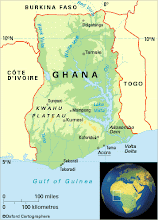
Day 13: The journey north – Saturday, 23 January 2010

A 6.30am start enabled us to avoid much of the Accra traffic, but unfortunately a lorry had overturned on a section of unmade road leading to a long tailback. This, and the long sections of unmade roads, made the journey north a long one.


In fact, we could have flown from Accra to Heathrow and back again in the same amount of time it took us to travel from Accra to Bolgatanga.

The dust on some of the roads made driving very difficult.


However, it must be even more difficult for the people who live along side these unmade roads because, as you can see from the colour of the leaves on the tree and the roofs of people’s homes in the photo below, the dust covered homes and vegetation for a distance of at least 50m from the road.


As it was a Saturday, we passed many people on their way to funerals. Mourners in Ghana, especially in the south, traditionally wear red and black.


Another aspect of life on Ghana’s roads we were becoming used to, are the slogans people put across the rear windows of their vehicles. Most are religious in nature.


Whilst others relate to something else many Ghanaian hold dear.


We even saw one taxi with Tony Blair written across the back – I’m not too sure what that was all about!

Having first crossed the Black Volta River


We then crossed the White Volta before stopping for a bite to eat in Tamale at about 4.30pm.


After Tamale the road north was mainly surfaced (except for the large pot holes that is) and very straight.


It was interesting to note the change in scenery as we headed for the much hotter and drier north and what a contrast the grass savannah was to the much lusher tropical south.


Approximately fourteen hours after starting out from Accra, we eventually arrived in Bolgatanga. Our driver, Isaha, had done a tremendous job of getting us here safely. Driving on Ghana’s roads requires total concentration, so he must have been exhausted after such a long day.

Day 9 - 12: VSO In Country Training - Tuesday, 19th January to Friday 22nd January 2010

The Hotel


On 19th January we said our goodbyes to Mariam and Darligton who had looked after us so well at the villa and moved to the Hotel Byblos in central Accra. On the outside the hotel looked promising, but looks can be deceptive!

On the inside the standard of accommodation and the level of customer service we experienced left a lot to be desired. Aspects of it were like Fawlty Towers on a bad day! Certainly not a hotel I would recommend anyone to use.

The three of us were originally shown rooms in the annex area across the road from the main hotel. Shortly after lugging my very heavy cases up the steep stairs (there is no lift) one of the hotel staff came and told me I had to move to different room in the main building! Getting the cases down the steep stairs was even more difficult than getting them up them in the first place, which resulted in them being dropped and bounced down a number of stairs more than once – fortunately there wasn’t much in them to break!

The new room I was allocated was just off the reception area – good news as it meant I would not have to carry the cases up yet more stairs. The bad news was that as soon as the door was opened there was an almost overpowering smell of damp coming from the room. Mosquitoes in the room were also a problem as the screening on the window was missing on one half and broken on the other. There were plenty of gaps in the window frame for these pesky insects to enter. That night I got no sleep due to the nauseating smell and noise from the air conditioning unit which had no control unit to turn it to the sleep setting. The next morning I had a splitting headache and felt quite nauseous. For those of you who know what I am like when I have had insufficient sleep, you can imagine what sort of mood I was in!


The shower did have hot water, but the shower curtain was useless and drainage was very poor. After a short period of time the water overflowed the shower and flooded the bathroom floor. The toilet flushed, but the seat was loose so it had to be used with care!


For breakfast there was a choice of egg and bread or bread and egg! Not good for a person who has a problem with eating eggs!

I asked to see the manager, but he wasn’t available. My colleagues in the annex had similar issues, but also had the added concern about the lack of security as the outside door to the annex did not lock so was open all night. The hotel’s annex is the building next to House of Spirits below. The pink building is a new expensive night club – Citizen Kofi.


I think it is too easy to say “What do you expect in a developing country.” The fact is that we live in an ever shrinking world and tourism is a potential source of significant foreign income for countries like Ghana. However, people will only travel to such places if the essentials are right, i.e. basic cleanliness, maintenance and an acceptable level of customer care. I also believe that organisations such as VSO have a role to play in raising standards. Businesses should only receive their custom if certain standards are met and checks should be conducted to ensure minimum standards are maintained. Businesses that fail to meet these expectations should lose their custom until deficiencies are put right. Such action would support the overall raising of standards, which can only be in everyone’s interest.

The irony of our experience at the hotel is that we calculated it would have been cheaper for VSO to have put us up at the villa than in this sub-standard hotel!

Restaurants

Our experience of restaurants in Accra was similar to that of accommodation. The Lebanese restaurant attached to the hotel had shabby furniture, tatty menus, slow service and uninspiring food – needless to say we only ate there once. A short distance away there is an Italian restaurant, Leonardo’s, that has excellent decor and some of the best service I have experienced anywhere in the world. The food was also great and very reasonably priced. As we enjoyed our first meal there so much we returned the next day to sample something else from their extensive menu and to celebrate my birthday (and the fact that I was entering my 50th year!) a few days early.


In Country Training

As there were only the three of us that needed training, we had an intensive few days to cover all the things we need to know before heading north.

Dora, who is responsible for the VSO education programme in Ghana, gave us a comprehensive overview of Ghanaian education system and the issues affecting education, whilst Eric informed us about the Tackling Education Needs Inclusively (TENI) project. We thought the UK was bad for acronyms, but I can assure you Ghanaians win hands down! Their guiding principle appears to be why use words when a string of letters will do! We also had a briefing on cultural practices from Nii and a health briefing that made us all want to return to the safety of the UK!

Day 8: 18 January 2010 - University of Cape Coast

After an early start we arrived at the University of Cape Coast (UCC) to find out more about initial teacher training in Ghana and the Teacher Education in Sub-Saharan Africa programme. UCC’s campus must enjoy one of the most idyllic locations of any university in the world with its palm lined avenues, manicured grounds and panoramic views over the Gulf of Guinea coastline.


Our hosts from UCC’s Institute of Education, Might and Kwame, had arranged for us to meet a Tutor from a local teacher training college and a qualified teacher.


We had an extremely useful meeting in which we found out about the course student teachers follow. It differs significantly from courses in England, as in Ghana trainee teachers do not go on teaching practice until the third year of their three year course. We also discovered that due to the shortage of teachers, nobody who remains on the course for the duration fails – regardless of how poor their classroom practice is! It also appears that due to the lack of status associated with teaching as a profession, it is often not the first choice for many of those who train to teach.

We had an enjoyable lunch at a nearby centre for Ghana’s Teachers’ Union. We approved of its motto!

Sunday, 31 January 2010

Day 6 & 7: 16-17 January

On Day 6, Madam Gertrude insisted that we allow her seamstress to make a typically Ghanaian outfit for us. After selecting our preferred styles from numerous designs displayed on posters, measurements were taken. Our host even arranged for the finished articles to be delivered to the VSO office in Accra – photo to follow?

The rest of the day was spent travelling back to the villa in Accra.

On Day 7 our driver, Darlington, had suggested we might like to go to the beach. What he forgot to tell us was we were going via the Shai Hills Resource Reserve. I had forgotten my water and Janet had dressed for the beach!
The Reserve consists of a very striking range of rocky hills surrounded by coastal savannah. We saw many species of birds, including wild Guinea Fowl and Grey Hornbill, as well as bats, baboons and Kob antelopes.


This stick insect caused Janet to panic when it decided to hitch a ride – fortunately it was rescued by the guide before it came to any serious harm.


Our guide also took us to the caves once inhabited by the Dangme Shai people. This tribe was removed from the land to make way for the Reserve.


In discussion we asked our guide, Michael, about his role. He explained that their job was to stop poaching and to show visitors around. We asked how many female guides there were on this Reserves and similar sites around the country. To his knowledge there weren’t any. He thought this was entirely appropriate as he did not feel that women would be able to cope with the physical demands of hiking through the savannah and camping over night.


After a short hike that even we three women were able to manage, we entered one of the caves that were used in the past by the Chief of the Dangme Shai tribe and encountered hundreds of bats. The stench created by these mammals was very strong and the colony took flight as we approached.  It was amazing to see how so many of these creatures were able to fly around in such a confined space without colliding with each other.


At one of the dams used to create watering holes for animals, there was a rustling in the bushes followed by a quick glimpse of a large gold and black snake - a rock python! Pythons are non-venomous and completely harmless – that is unless you are a small antelope or rodent, in which case they might crush you to death before swallowing you whole!


In the Shai Hills ticket office I came across these exercise books – I don’t think this was the intended use of these resources!


At the end of our tour of Shai Hills Reserve we headed for the beach.


On the way back to Accra we listened to Arsenal defeat Bolton 2-0 on BBC World Service and were greeting by an amazing spectacle over the city’s night sky as literally hundreds of thousands of bats took to the night sky to head off to the surrounding countryside to feed overnight.

Saturday, 30 January 2010

Day 5: Friday, 15 January

Kente cloth workshop
On the way to visit Walton High’s two partner schools, Jamasi Methodist Junior High School and Akrofonso District Assembly Junior High School, we stopped off at a Kente cloth workshop to see the fabric being woven by men in the traditional way.


Kente cloth is worn by the Akan tribes during important ceremonies, but is world famous patterns and bright colours are now used to make many other products as well, including bags, flip flops, tablecloths and blankets.


Outside the workshop there were a number of children playing and the five youngsters below kept asking for their photograph to be taken, so we obliged.


Jamasi Methodist Junior High School & Akrofonso District Assembly Junior High School

We received a typically warm Ghanaian welcome from the staff and students at both of Walton High’s partner schools. Two classes joined together for an interesting question and answer session. We were encouraged to practice our very limited Twi. Thanks to the coaching I received from Bismark, one of Walton High’s caretakers, my effort received a round of applause, whilst my colleagues’ attempts were received with much laughter!


Despite the temperature being easily well over 32C a couple of students were wearing their jackets because they thought it was a bit chilly!


One of the questions we asked the students was about the start of their school day. Children arrive at 7am to clean the school and then they parade. During the parade they sing the national anthem and recite their pledge to Ghana. I asked one of the students looking on outside the classroom to video this for us. Stephen soon got to grips with the camera. Unfortunately, I am unable to upload the video at the moment because of the limitations of accessing the internet over a mobile modem. However, once I am able to do so I will add it to the blog.


Students were also asked what changes they would make to their school if they were the headteacher.  We had some interesting responses to this.  One boy said he would not allow teachers to beat the students - many others in the class also thought that this was a good idea.  They also wanted more after school clubs.  It appears that some extra curricular activites have stopped due to a lack of funds to run them.

The students were just as keen as the children in the street to have their photograph taken – it was clear that their concept of personal space and mine were very different!


Before we left Jamasi School we asked one of the teachers whether there was a toilet we could use. He replied that he would arrange for there to be one – which we thought was rather an unusual reply. Then Stephen, the boy who had videoed the class, arrived to escort us. We thought we were being shown where the school’s toilet was, but instead we were taken to his house! As he walked into the courtyard his mother looked up in surprise when she saw three white women in tow! It turned out that we were taken there because they had a water closet, i.e. a western toilet. Again, typical of Ghanaian hospitality, the family welcomed us to their home and allowed us to use the toilet.

The pictures below show the well in the courtyard of Stephen’s home and his baby brother cooling down in a large bowl of water.


As we left Jamasi School, the younger children waved us off.


Due to time constraints, we were only able to make a flying visit to Akrofonso School. We were greeted by both children from Walton High’s partner school and those from the school next door (the younger children in blue uniforms).


Many of the children at both of Walton High’s partner schools come from families that are surviving at subsistence level. Whilst education is free in basic schools, i.e. up to the age of 15 or until they successfully complete JHS3, families still have to find the money for uniforms, stationery and exam fees. This is a significant financial burden for most.


The Ghanaian Government is rightly concerned about Ghana falling further behind the rest of the world with regard to information and communication technology and as a result it has made ICT compulsory in all schools. Akrofonso School did have a few old second hand computers which were donated by a Ghanaian now living in the USA, but unfortunately they were not working when we visited. Mr Alfred, the Partnership Co-ordinator at Jamasi School, explained that he would also like to see a computer room at his school. We had a useful discussion about the practicalities of this, but as his school has electricity it is better placed than many to achieve this.